
When South Campus got bees, Christ appeared in the beehive
After seven years with bees at South Campus, theologian and associate professor emerita Gitte Buch-Hansen is handing over responsibility. But the story of the beehives is about much more than honey. It is about cultural history, community, and a question that the bees brought with them: What happened when people discovered that the bee king was actually a queen?

Next spring, the bees at South Campus will get a new beekeeper.
Who that will be remains unknown. But one thing is certain: the bees of South Campus are about much more than honey. Why are there bees at South Campus in the first place?
“My research colleagues, Jakob Skovgaard-Petersen and Ditlev Tamm, were the driving forces behind the idea that South Campus should have a couple of beehives. They believed that bees were such an important part of our cultural history that they also belonged among the more academic disciplines on Amager,” Gitte explains.
That idea came to shape the entire project. The bees quickly proved to be a prism through which questions of religion, history, law and culture could be explored.
The bees swarmed into the research
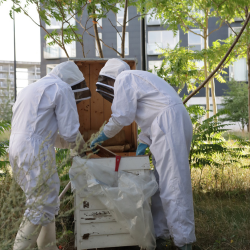
When Gitte began caring for the beehives, she had not imagined that the bees would also find their way into her research.
“It actually had nothing to do with my research. My desire to work with bees came from my childhood. My grandparents did not keep bees themselves, but their neighbours did, and honey sandwiches were a part of every holiday I spent with my grandparents.”
Instead, her work with the South Campus bees led her to early Christian traditions in which honey played an important role.
“In Hippolytus’ baptismal ritual from the third century, honey is part of the ceremony. The person being baptized was expected to bring wine, bread and honey. Wine and bread are familiar elements in the Christian tradition, but the honey serves as a pledge of eternal life. It symbolises the transformation that begins at baptism, where the baptised person gradually begins the journey towards becoming a spiritual being,” says Gitte Buch-Hansen.
Honey also led her into some of the major theological debates of the early Church.
“During the same period, a central controversy in the early Church concerned the nature of the resurrection. Is it about rising again in a body of flesh and blood, or is one spiritually transformed through Christ into God?” asks Gitte Buch-Hansen.
The fact that the resurrection became a point of contention in the early Church may be linked to the emergence of the idea of the “twofold outcome”, namely the belief in an afterlife either in heaven or in hell.
“If you do not have a body, then you cannot experience pain or punishment either. In fact, we have sources that directly describe the concept of hell as a pedagogical tool of salvation, intended to frighten people into the right path,” says Gitte Buch-Hansen.
The bees also led Gitte to lesser-known aspects of Christian history.
“In the Byzantine manuscripts of the Gospel of Luke, the resurrected Christ is offered fish and honey. However, that variant disappeared from twentieth-century Bible translations. Now he is offered only fish.”
When Christ was the bee king
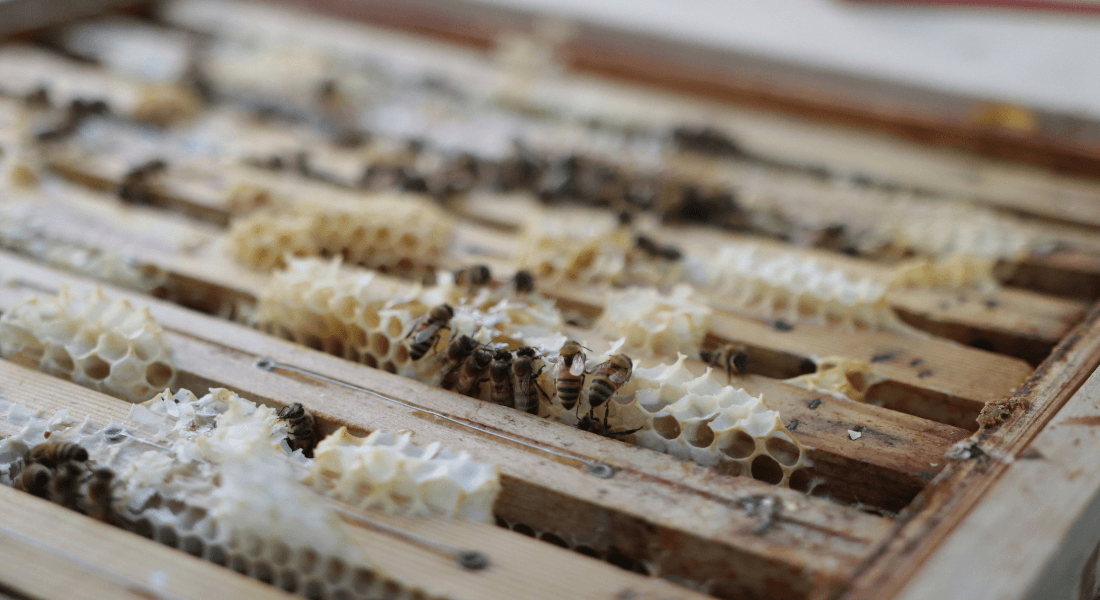 Until the seventeenth century, people were convinced that the queen bee was actually a king. The belief was so widespread that it became incorporated into Christianity.
“From Aristotle’s writings on animal reproduction, we know that people in antiquity debated the sex of bees. Aristotle himself concluded that the queen bee must be a king, because without a king in the hive there would be disorder and no offspring. The Christian tradition adopted that understanding. The beehive became a symbol of the Church, while the ‘bee king’ naturally came to symbolize Christ. Even the Pope’s tiara is shaped like a beehive, precisely because the Pope is regarded as Christ’s representative on earth.”
But what happened to a symbol that had been used for centuries once people realized the truth?
“I think it took some time before the discovery made its way into the Church. It happened at a time when beekeeping had become more pragmatic, with the production of honey and beeswax playing a role in the economy. During the nineteenth century, bees increasingly became part of a modern view of nature, where they came to represent diligence, discipline and usefulness rather than religious symbolism,” says Gitte Buch-Hansen.
After-beeing
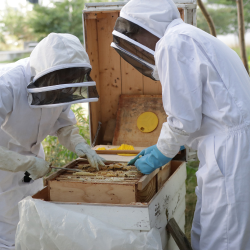 Over the years, a community has developed around the bees.
A beekeeping guild consisting of students and staff from Theology, Nanoscience, and administration has cared for the bees together from April to September. After the work was done, the group gathered for what they call “after-beeing”. The conversations around the beehives were about far more than bees.
“For the young women in the beekeeping guild, it has become a place where they can exchange views on everything from humanity’s relationship with nature to abortion, theology, faith, and other major questions.”
According to Gitte, this is closely connected to the nature of the work itself:
“Beekeeping is a way of engaging with the non-human world in which, for once, we are forced to submit ourselves. Because the bees are the ones in charge. Working together in the apiary requires a great deal of trust. You become very aware of what the others are doing because the work largely depends on sensing where the bees are and what is happening around them. You have to remain extremely focused. If someone drops a frame or a hive box, it can put the bees on alert, and it is very unpleasant to find yourself standing in the middle of a swarm of angry bees.”
Who will take over?
 Now the question is who will carry the story, and not least the community, forward.
The bees are still there, and they have fared remarkably well. When an experienced beekeeper recently inspected the colonies, his assessment, according to Gitte Buch-Hansen, was:
“The knowledgeable beekeeper said that he had never encountered bees as calm as ours. I was just so proud!”
At the same time, the colonies have survived for seven years, even though annual bee mortality in Copenhagen is estimated at 30 to 40 percent.
“These colonies have survived for seven years. That is truly exceptional.”
Next spring, a new beekeeper will take over responsibility. Not only for two beehives, but also for a small piece of cultural history at South Campus.
And perhaps also for the question the bees leave behind:
How did the Church react to the fact that the bee king, in other words Christ, turned out to be a queen?