
Research
2025.11.05
This project deals with the influential Danish theologian, hymnwriter, and educational thinker N.F.S. Grundtvig. The purpose is to identify Grundtvig’s sources from antiquity to his own day and analyse how these sources shaped his ideas in order to clarify his place as a pivotal figure in international intellectual history.
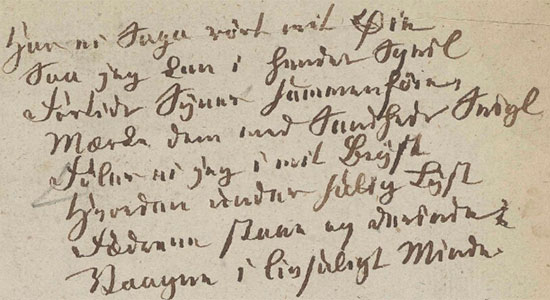
Grundtvig often does not reveal his sources in his printed works. Therefore, researchers have traditionally struggled to identify what sources he drew upon. To remedy this problem, the research team members will use the new research infrastructure, Grundtvig's Manuscripts Online, which transcribes the more than 80,000 unprinted pages in Grundtvig's Archive and provides comprehensive new information about which authors and texts influenced Grundtvig’s thinking.
The project builds on thorough pilot investigations of Grundtvig’s interactions with international, historical texts and proposes that his writings can to a large extent be seen as a result of how he translated, evaluated, and reshaped these sources. By the project title, Writing with the Dead, we wish to argue that Grundtvig in his writings used sources from the past and, simultaneously, engaged in a dialogic relationship with their authors. The governing hypothesis is that it is possible to demonstrate:
To pursue the objectives of the project, the team members will work individually with Grundtvig’s sources from specific historical periods and collaboratively as a team by:
PhD-Student, NN
Researchers have claimed that Grundtvig’s view of Early Church writings did not spring from his study of sources. Other researchers emphasise his deep dependence on the Eastern theology. A substantial group of previously unnoticed fascicles shows that Grundtvig intensively studied Western theology (e.g. Justin Martyr, Hippolytus, and Augustin) and clearly preferred it to Eastern theology. Grundtvig also read numerous non-Danish patristic scholars. The PhD project should investigate Grundtvig's studies and uses of source material from Late Antiquity/the Early Church.
Co-I, Mark Bradshaw Busbee
In English literary studies, Grundtvig is known as a pioneer in the study of the Old English epic Beowulf. Research on his commentaries, editions, and translations of Old English poetry has made some use of the approximately 1,500 handwritten pages of unpublished writings about Old English literature in the archive. Many manuscripts remain unexplored and can provide substantial new insights – e.g., how Grundtvig understood the place of Anglo-Saxons in world history. The project will investigate the Old English material including transcriptions and translations.
Postdoc, Lea Grosen Jørgensen
Grundtvig’s work with medieval chronicles (including Saxo and Snorri) is well known. However, the archive provides new information about the many other medieval sources he also studied (i.e. the chroniclers William of Tyre, G. Villani, and Ericus Olai) and insights about his participation in interpretative debates with Enlightenment historians and Romantic thinkers (e.g. J.C. Gatterer, J.L.S. de Sismondi, and F. Schlegel). The project aims to reorientate research on Grundtvig’s view of medieval history.
PI, Anders Holm
Research has provided several specialised articles on Grundtvig’s disposition towards Luther and the Reformation, but no comprehensive scholarly study exists. To date, it has been unclear which writings of reformers and their successors Grundtvig consulted and which Danish and German literature he polemicised against. Analysis of more than 200 unexplored fascicles about Luther and the Reformation in the archive will help answer these questions.
Postdoc, Nanna Eva Nissen
A trove of unexplored manuscripts contradicts claims of most Grundtvig research by showing that Grundtvig was also strongly influenced by new ideologies in the 18th century. The fascicles make it obvious that Grundtvig adopted his understanding of human consciousness from 18th century Psychology, which, like Pietism and Enlightenment thinking, bears witness to a new view of humanity. This project aims to shed light upon Grundtvig’s combined criticism of and dependence on Die Neuzeit.
CO-PI, Sune Auken
Grundtvig regarded his hymns as more a record of the collective voice of the faithful through history than an expression of his own creativity. Consequently, many of Grundtvig’s 1,600 hymns are translations and adaptations of previous religious poetry and therefore dialogic in their use of sources. This project analyses the hymns as an exchange between Grundtvig and his many historical sources. The project will make use of a new GMO register of all available hymn drafts.
PhD student, Cathrine Zander Ebdrup
Using digital facsimiles and transcriptions of his sermons, this project examines Grundvig’s writing processes, revisions, and genre experiments to analyse how he drew upon vast numbers of historical and biblical sources. By combining genre theory and homiletics the study aims at offering new perspectives on Grundtvig’s preaching and nineteenth-century Lutheran sermon culture.
Co-I, Kim Arne Pedersen
The scholarly assessment of N.F.S. Grundtvig's relationship with the Jews has swung from idealisation to condemnation. Both assessments, however, have neglected his sources. If one holds his unpublished manuscripts together with his printed texts, threads can be traced back to older Lutheranism, the Early Church, and New Testament eschatology, which together shed new light on pro- as well as anti-Jewish statements in his writing.
Grundtvig’s main source is the Bible. Research has shed light on how his use of the Bible developed after 1825. However, numerous unexplored fascicles in the archive contain information that will challenge existing research. An investigation of Grundtvig’s use of the Bible as a source is essential for the project but requires many scholarly perspectives. Therefore, we will organise a conference in autumn 2027 that will result in an anthology with contributions from the research team and invited speakers. Prior to the conference, all participants will be asked to join three online training sessions in GMO, and they will be provided with unexplored material for the conference proceedings.
This international conference will add an overarching perspective to Grundtvig’s use of sources and genres. The conference will be held in autumn 2028. Prior to the conference, participants will be asked to join three online training sessions in GMO and all will be provided with previously unexplored material. A main purpose of this conference is to create a more stable international network in Grundtvig research.
| Name | Title | Phone | |
|---|---|---|---|
| Auken, Sune | Associate Professor | +4520562022 | |
| Busbee, Mark Bradshaw | Guest Researcher | ||
| Ebdrup, Cathrine Zander | PhD Student | +4535335916 | |
| Holm, Anders | Associate Professor | +4535323702 | |
| Jørgensen, Lea Grosen | Part-time Lecturer | ||
| Nissen, Nanna Eva | Assistant Professor | +4535333482 | |
| Pedersen, Kim Arne | Associate Professor | +4535331918 |