
Africa Seminar: Slow Fashion and Cyclical Time: On the Temporality of Garments in Urban Africa Today
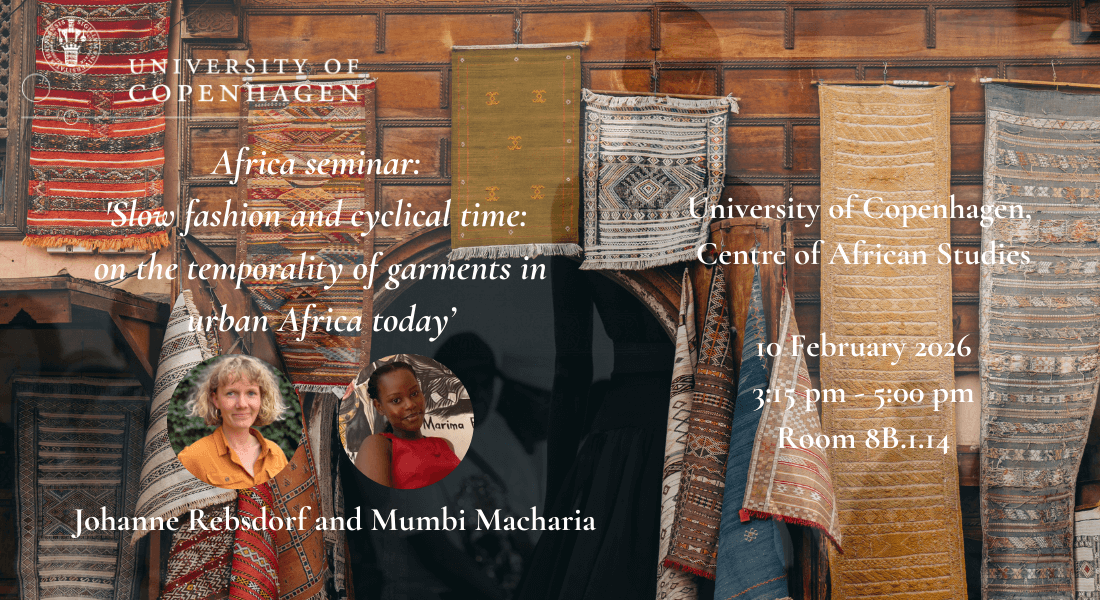
Global textile production today is shaped by linear value chains and a temporal logic that fills weeks, hours, and minutes with as many product sales as possible. This logic fuels a consumer culture in which garments are discarded as soon as they lose their sense of newness, and it rests on an abstract notion of time as a force determining decay detached from the material world. Yet in African cities facing the consequences of global textile waste, new initiatives seek to both curb overconsumption and challenge the temporal imperatives of fast fashion.
This seminar draws on examples from community-based fashion events in Nairobi and fashion businesses in Kampala to explore how temporality in textile can be challenged, unlearned, or exploited.
Grounded in African philosophies of time and contemporary fashion interventions, Mumbi shows how fashion can be understood as a temporal practice. Many African fashion practices operate within event-based, relational, and reparative temporalities, where garments gain meaning through use, repair, circulation, and social life rather than linear obsolescence. Here, slowness becomes a decolonial strategy that challenges industrial notions of time, value, and waste, making fashion a medium for alternative futures and ethical relations.
At the same time, Johanne’s upcoming fieldwork in Kampala explores what happens when slow fashion practitioners tap into a global industry driven by short lead times and product‑per‑minute logics. Her work with upcycling studios that transform imported used clothing into high‑end designs examines how these actors navigate European fashion circuits, encounter conventional brands, and attempt to carve out space for circular and slow business models without being absorbed by a fast and linear industry.
Presenters:
Johanne Rebsdorf is a PhD-student at the Centre of African Studies at UCPH. With a background in business Anthropology her research focusses on Ugandan circular fashion and the import of used clothing to Africa, as well as the role of African fashion studios in the green transition of the textile industry.
Mumbi Macharia is a researcher, writer, poet, and performing artist working at the intersections of African temporality, culture, and decolonial thought. With a background in Law and African Studies, her work examines how time is lived, marked, and resisted through everyday practices such as language, art, and fashion.