
CAS welcomes new researchers on the ERC Starting Grant Modelling African Futures
The Centre of African Studies is pleased to welcome two new postdoctoral researchers, Edwin Ambani Ameso and Cecilia Passanti, as well as PhD Fellow Timothy Elikem Harvor. All three join the ERC-funded project Modelling African Futures: A comparative technography of evidence-based welfare policy (ModelFutures), led by Associate Professor Alena Thiel.
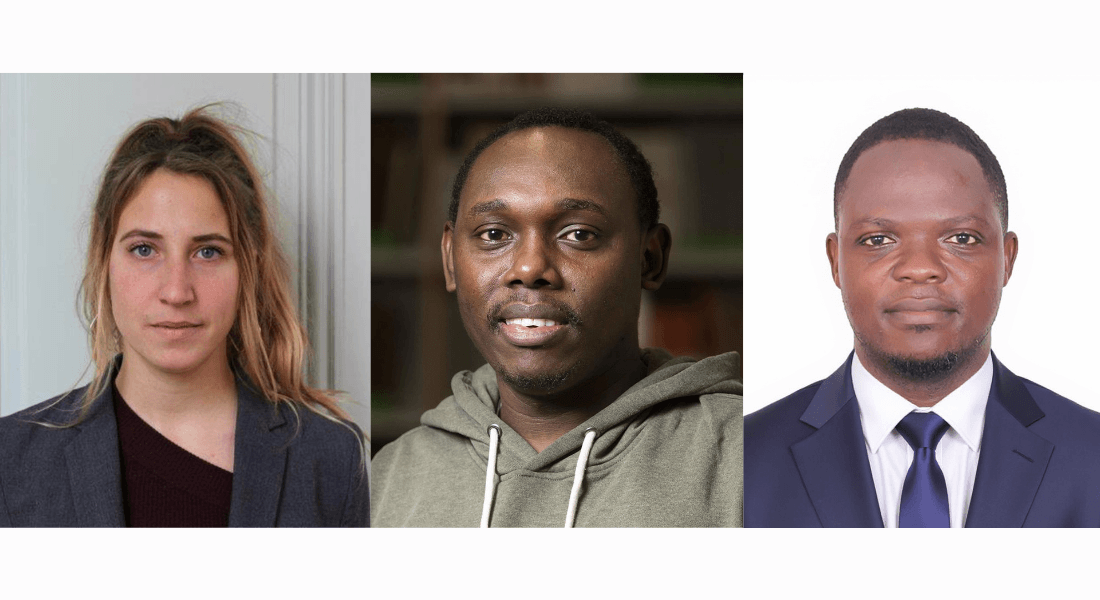
Edwin Ambani Ameso joins CAS as postdoctoral researcher on the ModelFutures project. His research focuses on digital health technologies, healthcare and welfare, and infrastructures of care, with particular emphasis on medical anthropology, the anthropology of health insurance, social welfare and citizenship studies, and infrastructure studies.
Edwin holds a joint PhD in medical anthropology from Aarhus University and University of Oslo, where he focused on Kenya’s pursuit of universal health coverage through prioritization of health insurance and social welfare reforms. In his previous position at the University of Leipzig, he researched the rise of medical drone technologies in Malawi and Ghana, analysing how techno‑optimism shapes healthcare delivery. He has explored how the use of medical drones shapes healthcare delivery as part of the ongoing techno-optimism shaping care trajectories. Edwin's current research will build on insights from his earlier doctoral trajectories and his work with digital health technologies to explore how access to healthcare is being reconfigured by ongoing technological pursuits.
Cecilia Passanti joins CAS as postdoctoral researcher on the ModelFutures project. Her research focuses on IT/digital reforms to the civil registry in Senegal and how they relate to the production of population statistics. By reconstructing the complex and constantly evolving network of population databases that shape Senegalese public administration today, her fieldwork focuses on the everyday work of experts - particularly statisticians and computer scientists - at the intersection of civil registration, identity management, and vital statistics.
Cecilia's academic training combines anthropology (bachelor’s degree, Università degli Studi di Siena), history of science, technology, and society (master’s degree, École des Hautes Études en Sciences Sociales), and political science - African studies (master’s degree, Université Paris 1 Panthéon-Sorbonne).
Before coming to Copenhagen, Cecilia was an associate researcher at the Centre Population et Développement (CEPED) at Université Paris Cité, where she earned her PhD in Science and Technology Studies (STS). She was recently awarded the Brooke Hindle Postdoctoral Fellowship from the Society for the History of Technology (SHOT) for a study of an early biometric computer project conceived to identify Senegalese voters for the first multiparty elections after independence.
Timothy Elikem Harvor joins CAS as a PhD Fellow on the ModelFutures project. He holds an MPhil in environmental science and a BA in Geography from the University of Ghana. Professionally, he brings nearly a decade of experience in geospatial analysis and disaster risk management. Most recently, Timothy serves as the director of the Geospatial & Big Data Unit at the National Disaster Management Organization (NADMO) in Ghana.
Timothy's PhD research constitutes the Ghanaian case study for the ModelFutures project. He is focusing on ‘modelling welfare futures, assessing statistical infrastructures and examining the politics of evidence in Ghana’s social protection system’. Using a technographic approach, he will investigate population registries and how the technical work of generating data, as in the case of the Proxy Means Testing (PMT), which is used for the Livelihood Empowerment Against Poverty (LEAP) program, shapes state responses to vulnerabilities and influences the legitimacy of welfare governance. His research aims is to provide an understanding of how data infrastructures and political incentives interact to design inclusive welfare policies in Ghana.