
Karen Lauterbach publishes paper on Music as Knowledge Production
Newly published research from Karen Lauterbach and colleagues followed a Ghanaian highlife band and community musicians producing music on water research, asking questions like: What forms of knowledge about water use and water experiences can the co-creation of music generate? What registers of knowledge does music draw on? And how does this knowledge situate itself in a research field that is closely linked to policy?
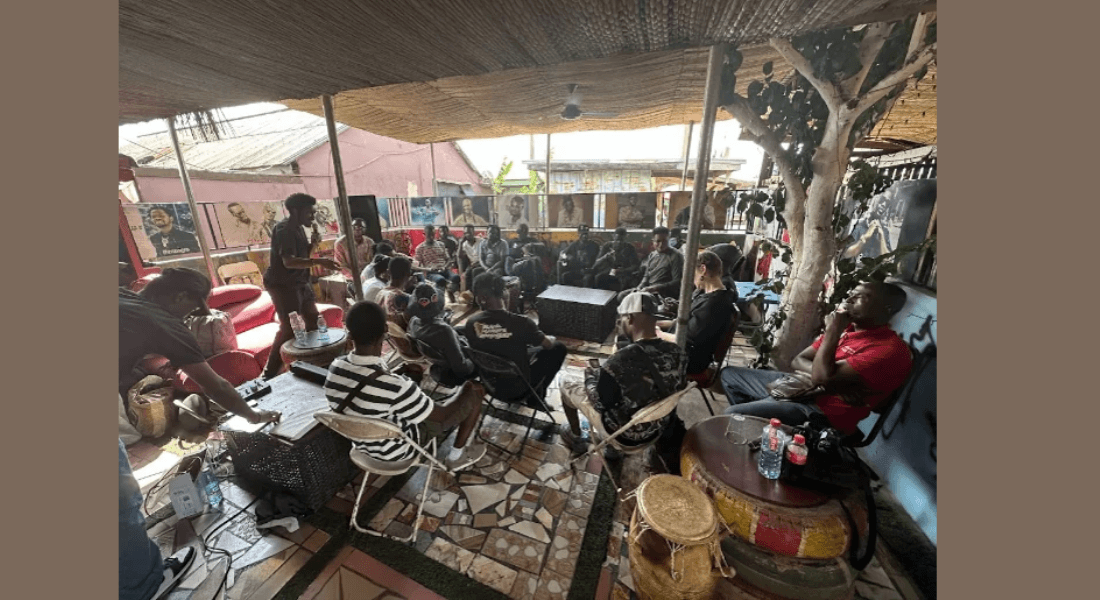
The paper by Karen Lauterbach and colleagues was recently published in CERN IdeaSquare Journal of Experimental Innovation and discusses co-creating music as knowledge production in water research in Ghana. By bringing together an established Ghanaian highlife band and community musicians from the study area, Lauterbach and colleagues were interested in generating knowledge from alternative epistemologies or vantage points.
The experiment included a song writing and open mic session in which the musicians engaged with community members to reflect on their experiences with water access together. In this way, the artists, rather than the researchers, acted as ethnographers. The final product of the experiment was a song (entitled Nsu Pa (Clean Water)) accompanied by a music video. One of the insights of the experiment was that musicians were able to straddle different knowledge registers, and in this way encompass both practical and metaphysical aspects of the importance of water.
This also shows that when musicians work as ethnographers, they move easily between focusing on people’s experiences and thinking in terms of concrete solutions to the challenges they encountered. Moreover, oral traditions in Ghana (proverbs and music for instance) enable artists to convey criticism and political tense questions in an implicit way, which can facilitate community debates about water challenges.
Link to music video for the song Nsu Pa by Amamere: Nsu Pa by Amamere feat. Billy Manin & Musa Haruna (official music video)