
Leapfrogging Care in Africa: Reflections from the Point Süd 2026 Conference at Makerere University, Kampala: Uganda
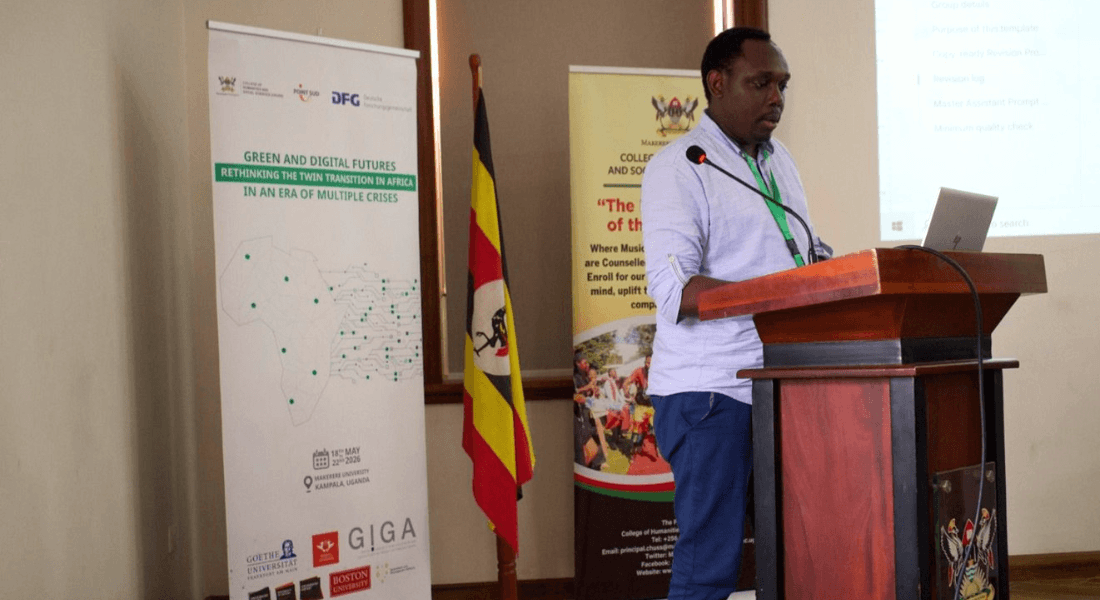
Author: Edwin Ambani Ameso Postdoctoral Fellow, Centre of African Studies, University of Copenhagen | ModelFutures ERC Project
From 18 to 22 May 2026, I joined the Point Süd 2026 Workshop on Green and Digital Futures: Rethinking the Twin Transition in Africa in an Era of Multiple Crises, hosted at the College of Humanities and Social Sciences, Makerere University, Kampala, and funded by the Deutsche Forschungsgemeinschaft (DFG) under the Point Sud programme. Convened by Dr. Evans Awuni (University of Erfurt) with an international team — Prof. Achim Kemmerling, Dr. Davina Osei, Prof. Elvis K. Avenyo, Dr. Solomon Owusu, Dr. Peter Nareeba, and Dr. Victor Osei — the five-day workshop brought together scholars, policymakers, technologists, and grassroots innovators from Africa, Europe, and the Americas to interrogate the entangled green and digital transformations now reshaping African political economies.
The workshop departed from a clear provocation: that "twin transition" narratives too often travel as technocratic win-win scripts, obscuring distributional conflict, institutional constraints, and transnational power asymmetries.
Edwin's contribution
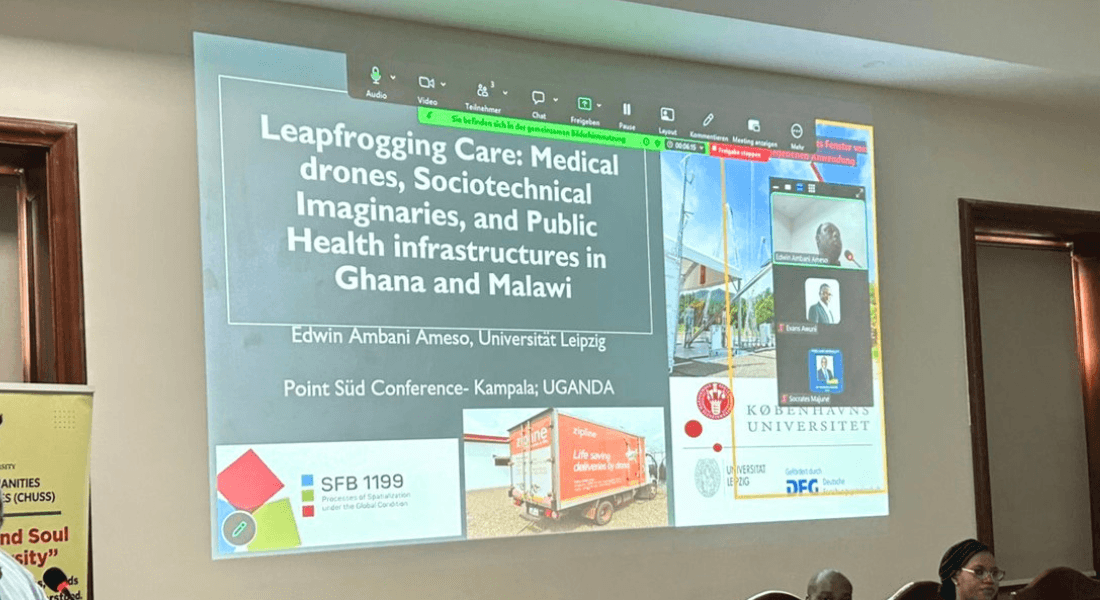
In Panel 3 on Digital infrastructures, data, and algorithmic governance, I presented "Leapfrogging Care: Medical Drones, Sociotechnical Imaginaries, and Public Health Infrastructures in Ghana and Malawi." Drawing on comparative ethnographic fieldwork conducted between 2020 and 2024, and working with Jasanoff and Kim's concept of sociotechnical imaginaries, I argued that medical drones do not simply solve infrastructural problems — they reorganise infrastructures through new forms of governance, labour, platform dependency, and environmental relations.
The Ghana–Malawi comparison surfaced two divergent trajectories. In Ghana, the state's formal partnership with the American firm Zipline has embedded drones into national health supply chains — delivering emergency medicines, blood products, vaccines, and anti-snake venom to remote regions — while producing infrastructural dependency on a private platform. In Malawi, a UNICEF-supported humanitarian testing corridor has hosted firms such as Wingcopter and Swoop Aero in fragmented, donor-driven pilots. "Leapfrogging," I argued, is not a universal technological pathway but a political process through which states, donors, and private firms reconfigure who has access to care, and on what terms.
Sustainability claims around electrified drone logistics, I suggested, obscure wider extractive dependencies — on lithium, mineral supply chains, and fragile energy systems. New occupational categories (drone pilots, swap-pod operators, digital health managers) are emerging under precarious and unevenly regulated conditions. Healthcare governance itself is being platformised through contracts, algorithms, and private data systems, raising urgent questions of labour justice, environmental sustainability, and data sovereignty.
Reflections
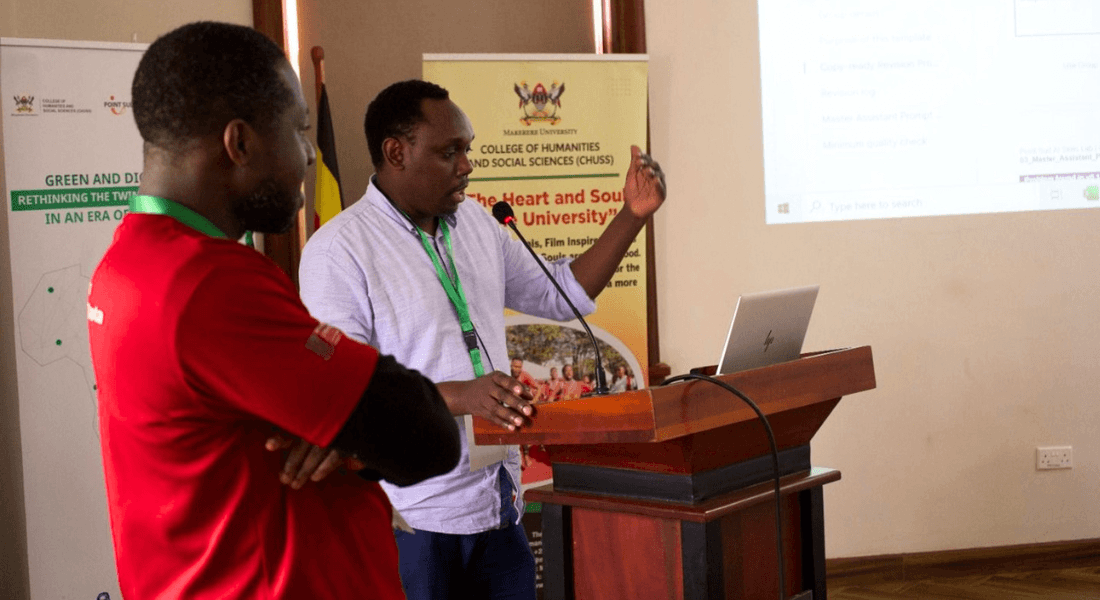
The workshop's strength lay in its insistence on grounding twin transition debates in African evidence, institutions, and epistemologies. Curated field engagements in and around Kampala anchored the scholarly conversation in ongoing initiatives at the intersection of digital innovations and climate response.
I return to Copenhagen with new collaborative possibilities, a sharper analytical vocabulary for thinking through platform dependency and infrastructural justice, and a renewed commitment to centring African evidence in conversations that too often unfold elsewhere — directions I will carry into my work at the Centre of African Studies and within the ModelFutures ERC project.
Sincere thanks to the convenors, the College of Humanities and Social Sciences at Makerere University, and the DFG Programme Point Sud for making this exchange possible.