
Interview with Nuno Grancho on new book chapter
To mark the publication of his new chapter “Public Shared Places and Private Absent Divides. Identity and Space of Colonial Urbanism under Portuguese, French, and Danish Rules: Diu, Pondicherry, and Tranquebar” in the Routledge Companion to Art and Challenges to Empire, we have interviewed author Nuno Grancho, architectural historian and privacy scholar.
Congrats on the publication of your chapter! In this chapter, you present a comparative case study of three colonial cities. You explain that these three cities and their relation to each other are underexamined, so I wanted to ask you what unique possibilities this comparative approach that you take offers in the study of these urban environments?
When I chose to examine Tranquebar, Diu, and Pondicherry together, the decision stemmed from a gap in the scholarship: although shaped by distinct European empires, the Danish, Portuguese, and French, these cities had rarely been placed in direct conversation. Placing them in a comparative framework offered a unique opportunity to probe how colonial urbanism operated beyond the dominant British paradigm and to question the long-standing assumption of a rigidly dual colonial city composed of separate European and Indigenous quarters.
This juxtaposition produced surprising and creative results. Despite each city's unique colonial heritage, there was a notable permeability between what could be considered "European" and “non-European” places. Europeans and non-Christians lived side by side within their guarded walls, sharing streets and urban areas. The esplanade and the fort did more than separate the inside from the outside. Additionally, they established a clear gap as a negotiating barrier, continuously changing what was considered private or public, coloniser or colonised. Through this comparative reading, we were able to see colonial authority as a spatial condition of ambivalence and hybridity rather than as an architecture of exclusion.
The chapter also highlighted the variety of imperial urban tactics. The Danish project in Tranquebar leaned toward pragmatism and coexistence. Fluid cultural hybridity characterized the Portuguese Diu. French Pondicherry, with its grid and canals, indicated a desire for order and difference. When I compared Tranquebar, Diu, and Pondicherry, it became clear to me that trade-based colonial powers, limited by their territorial reach, produced adaptive rather than strictly authoritarian architectural designs, frequently incorporating rather than replacing pre-existing fabrics.
In essence, the comparative method transformed the research question itself. It was no longer only about how each empire built its city, but about what emerged in the interstices, how spatial configurations became sites of interaction, translation, and everyday negotiation. Seeing these three cities together illuminated how architectural form materialized encounter and coexistence, and how colonial urbanism, far from being homogenous, contained within it spaces of resistance, hybridity, and shared inhabitation.
Therefore, the central issues for the production of the chapter were: questioning the dual-city paradigm, differentiating between Portuguese, French, and Danish imperial/colonial urban strategies, reframing public/private and inside/outside distinctions, bringing hybridity and contact zones into urban form, and recovering Indigenous agency and long-term urban effects.
In the introduction you write that these kinds of studies can help shed light on how art and architecture can challenge power systems. Can you elaborate a bit on how you see that happening in these three cases?
In the chapter, I suggest that art and architecture possess a dual capacity. They can consolidate structures of power, but they can also unsettle them. Tranquebar, Diu, and Pondicherry offer a striking demonstration of this ambivalence. Each was a testing ground where architecture both performed empire and revealed the fragility of its spatial order.
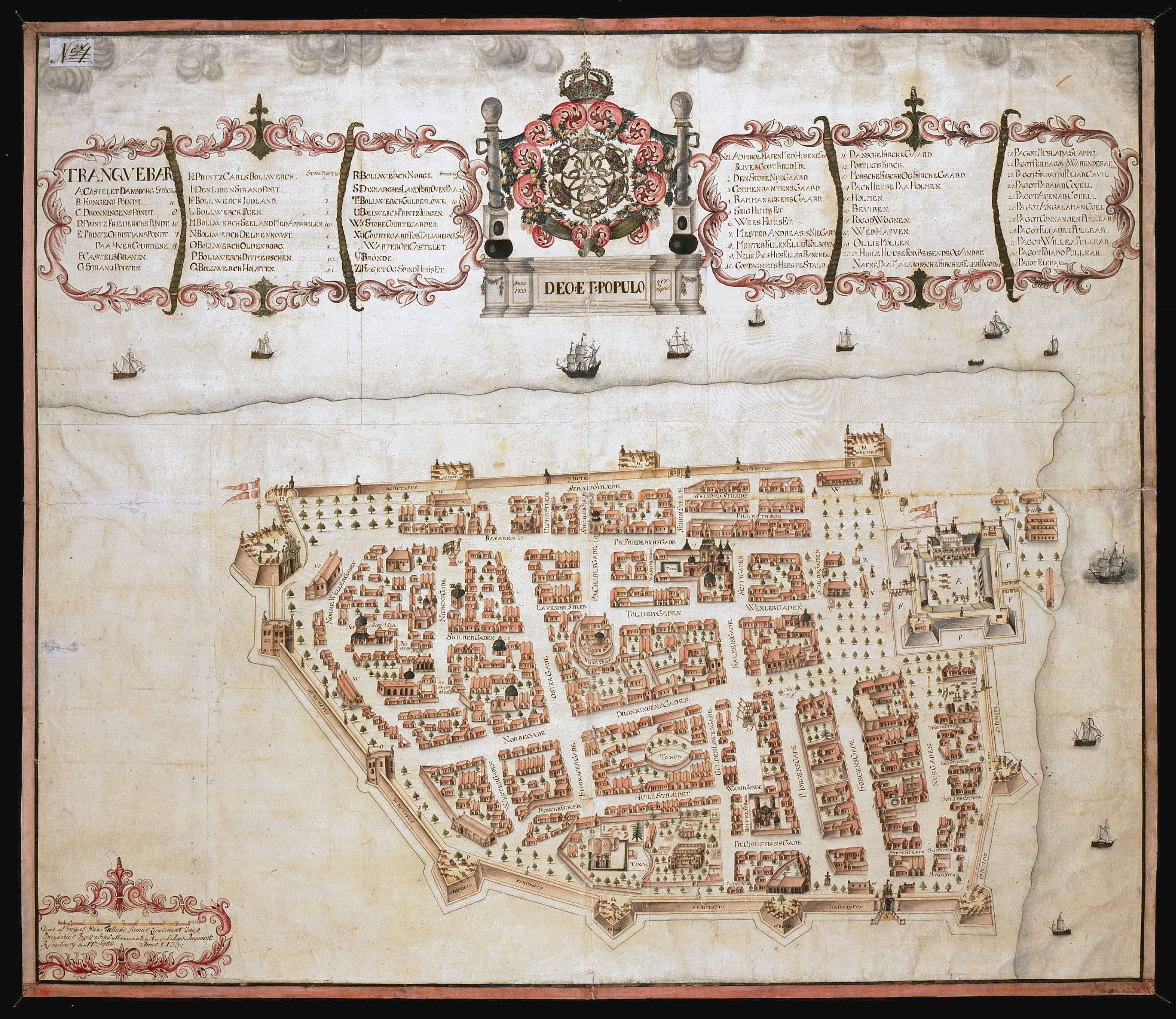
Tranquebar presents a more modest but telling example. The Danish project, visualized through the idealized Trellund map and the neoclassical geometry of Fort Dansborg, imagined a transplanted European town on Indian soil. Yet census data reveal extensive cohabitation: European, Catholic, Hindu, and Muslim households intermingled along the same streets within the same walls. The lived proximity of difference, therefore, subverted the visual rhetoric of order in cartography and architecture.
In Diu, for instance, the cartographic and architectural apparatus of Portuguese authority, including the Sarmento–Dechermont map, the fortress, and the esplanade, was designed to materialize a clear distinction between “Christians” and “gentiles,” between imperial order and local disorder. Yet in practice, the city’s dense Gujarati neighborhoods, caste-based enclaves, and fluid circulation patterns undermined that design. The map’s neat line of separation, intended as a symbol of control, instead becomes evidence of dissonance between imperial vision and urban life. Even the whitewashed churches lose their unambiguous dominance once they are read within the city’s multi-religious fabric, where their visibility depends on and coexists with the dense rhythms of Hindu, Jain, Muslim, and Zoroastrian communities.
In Pondicherry, by contrast, architecture embodied a similar tension between assertion and accommodation. The Dutch-French grid and canal system was designed as a tool for classification and regulation, embodying Enlightenment ideals of order and reason. At the same time, the persistence of irregular Tamil streets, sacred sites, and artisanal neighborhoods within the planned framework reordered the colonial city from below. The very instruments meant to display the rational superiority of French urbanism thus became evidence of its dependence on and eventual entanglement with local social geographies.
Taken together, Tranquebar, Diu, and Pondicherry reveal how artistic and architectural forms serve as both instruments and mirrors of power. They encode hierarchies, yet they also bear the imprint of negotiation, adaptation, and hybrid use. The comparative framework allows us to read forts, grids, and churches not merely as signs of domination but as archives of encounter, material records of how imperial authority was interpreted, translated, and at times quietly undermined by those who inhabited it. This is where the critical potential lies: architecture, seen through postcolonial eyes, becomes a medium through which the very structures of empire are not only represented but also reimagined.
You write that different colonizing nations such as the Brits, Portuguese, French and Danish had different ideologies when it came to architecture on colonized territories – what does this difference reflect?
The divergence in architectural ideologies among the British, Portuguese, French, and Danish colonialisms reflects profoundly different understandings of what empire sought to achieve, and how authority, identity, and encounter were to be materialized in space. The British, operating as a vast imperial power, approached architecture as a language of dominance and separation. Their presidency cities, Madras, Bombay, and Calcutta, embodied a logic of control through monumentalism and urban order, where the fort and the grid delineated a visible hierarchy. The clear boundaries between the “White Town” and the “Black Town” made spatial segregation itself an instrument of governance, a way to visualize the empire’s moral and social hierarchy.
Due to their smaller size, commercial focus, and reliance on pre-existing coastal networks, the Portuguese, French, and Danish colonialisms employed remarkably varied architectural methods that reflected their limited reach and unique cultural philosophies. Portuguese architecture in Diu developed into a deliberately hybrid style that combined regional materials, forms, and customs with European military geometry. This hybridisation was intellectual as well as artistic; it represented an empire that projected its authority through assimilation and negotiation rather than total spatial control, viewing contact and conversion as means of growth. French urbanism brought Enlightenment principles of politeness, order, and geometry to Pondicherry’s colonial setting. Even while the city's Tamil fabric continued to exist beneath and within this superimposed order, France's self-image as the rational and cultured empire was established by the urban grid and the canal, the design's defining features. As a result, indigenous patterns of life were never completely subdued by architectural control, creating a landscape of layered coexistence.
Tranquebar, the Danish settlement on the Coromandel Coast, reveals a distinctive colonial ethos, one shaped by pragmatic restraint rather than imperial ambition. Denmark, never an empire, maintained only a network of colonies in Tamil Nadu (Tranquebar), Bengal (Serampore), and the Nicobar Islands. In Tranquebar, this modest scale translated into an architecture of negotiation: the Danes built alongside local communities, weaving Tamil religious, mercantile, and domestic spaces into the same walled enclosure as their own European quarter. The city’s measured proportions and subdued forms speak to a colonial presence that sought legitimacy through coexistence, relying less on monumental assertion than on symbolic authority, shared purpose, and everyday accommodation.
When taken as a whole, these architectural philosophies reveal empire as a range of representational techniques influenced by scale, belief, and reliance, rather than as a singular artistic or spatial endeavor. Diu, Pondicherry, and Tranquebar's built surroundings turn architecture into a political tool that expresses the hopes and fears of colonial control while also exposing its negotiated and permeable nature. These varied manifestations of urban form show that colonial architecture was a dynamic, equivocal medium through which empires enacted, justified, and occasionally unintentionally undermined their own authority. It was never merely an imprint of power imposed on inert territory.
In your chapter, you argue that these three cities show a variety of ways of demarcating public/private spaces in colonial urban areas. Can you elaborate a bit on this? How do your case cities differ in this regard?
Tranquebar, Diu, and Pondicherry are used to demonstrate that the concepts of “public” and “private” in colonial urbanism were not fixed categories, but were produced differently through specific layouts, institutions, and the everyday uses of space.
Tranquebar reveals a porous, interwoven configuration of public and private spaces. Fort Dansborg and the parade ground define an obvious center of colonial authority. Yet census data and street patterns show that Europeans, Catholics, Hindus, and Muslims shared streets and blocks within the same walls, with domestic compounds, godowns, and gardens embedded in what might otherwise appear as civic or commercial fabric. Danish urbanism thus folds private mercantile and domestic spaces directly into the spatial field of the fort and main streets, creating a public realm that is structurally dependent on, and interwoven with, multiple forms of private life.
In Diu, the Portuguese attempt to draw a clear line between public and private is visible, apparent, and ideological. The Sarmento–Dechermont map inscribes a dividing line between “Christians” and “gentiles,” and the fort, along with its esplanade, establishes an apparently legible sequence from the most public, militarized, and governmental spaces near the fortress to more “private” Gujarati neighborhoods beyond. Yet, the reality of congested streets, caste- and occupation-based clusters, and mixed religious communities means that public streets function as intensely shared and negotiated environments, and the supposed public/private divide is constantly blurred in practice.
Pondicherry, by contrast, stages public/private through planning and the separation of functions rather than a single graphic line. Here, the Dutch–French grid, the canal as a cordon sanitaire, and the distinction between the European coastal quarter and the Tamil town organize public institutions, administration, and elite residences into clearly legible zones, while leaving Tamil neighborhoods to follow caste-based logics and irregular lanes. Public space, in this case, is strongly associated with French-controlled, gridded streets and institutional ensembles. In contrast, Tamil urban life is pushed into a more semi-public, communally regulated domain that remains spatially close but administratively distinct.
Seen together, Tranquebar, Diu, and Pondicherry validate that colonial demarcations of public and private ranged from cartographically inscribed boundaries (Diu) to planned separations of quarters and functions (Pondicherry) to more negotiated, mixed fabrics around a relatively modest center of power (Tranquebar). In each instance, formal devices such as walls, forts, grids, and canals aim to stabilize distinctions between colonial publicity and Indigenous privacy. The chapter demonstrates how everyday cohabitation and hybrid uses of space continually complicate and reconfigure those distinctions.
This chapter makes a point of dissolving classical dichotomies in favor of thinking of colonial history in more dynamic terms. Is this a principle throughout your research?
Yes, you are right. Throughout my research, the dissolution of certain classical dichotomies has been a guiding principle, forming the intellectual thread that connects my work on colonial architecture and urbanism.
I privilege fluidity over fixity, treating the colonial city as a lived space of negotiation rather than an abstract diagram of segregation. I contend that colonial modernity is defined not by absolute separation but by continual adaptation, translation, and the mutual entanglement of cultures. The move away from rigid dichotomies toward more dynamic, relational readings of colonial space is a core principle across my research, not just in this chapter.
Instead of taking categories such as public/private, European/Indigenous, center/periphery, or metropolitan/colonial for granted, my research on South Asian colonial cities has continually examined how these categories are created, contested, and destabilized through specific spatial arrangements.
My Marie Curie research project (INDIABRIDGE), housed at the Centre for Privacy Studies from 2021 to 2024, is based on this impulse. It specifically looks at how spatial-morphological arrangements both enable and unsettle distinctions between private withdrawal and public engagement in both Danish metropolitan and colonial contexts. I examine privacy/publicness and colony/metropole as two-way processes, with forms, ideas, and practices travelling between Europe and Asia and constantly being reconfigured, as opposed to perceiving them as stable oppositions.
In this sense, this chapter is representative: it uses the cities to show that public/private spheres, Black/White towns, and colonizer/colonized relationships do not operate as cleanly separated dichotomies and domains, but rather as overlapping and contested fields of interaction. That analytical move, which dissolves classical binaries to foreground hybridity, agency, and negotiated urban space, is emblematic of my broader research trajectory.
This chapter was written while you were still at the Centre for Privacy Studies. I was wondering if you could say a bit about how your experiences at the centre impacted your research in the years you were here?
Working at the Centre for Privacy Studies sharpened the conceptual and methodological tools that made this chapter possible, especially the insistence on treating public and private not as ready-made categories but as historically contingent, negotiated, and spatially embedded relations.
The Centre for Privacy Studies’ work method, its triad of terminological analysis, heuristic privacy zones, and semantic mapping, encouraged a way of reading Tranquebar, Diu, and Pondicherry, in which forts, esplanades, streets, domestic compounds, and religious buildings are examined as sites where notions of privacy and publicity are actively produced, contested, and re-signified.
The Centre for Privacy Studies’ explicit interest in thresholds as moments where individual or collective profiles emerge resonates with the chapter’s attention to mixed streets, shared bastioned perimeters, and cohabited inner cities as “contact zones” in which colonial authority is both enacted and unsettled.
At a very practical level, the heuristic zone framework, with its emphasis on thresholds and overlaps between, for instance, street and house, household and community, body and polity. This directly informed the chapter’s concern with walls, esplanades, and canals not just as infrastructural devices, but as instruments for drawing and disturbing boundaries between public and private, European and Indigenous, shared and withdrawn spaces in Tranquebar, Diu, and Pondicherry.
Finally, the collaborative, interdisciplinary environment at the Centre, which brings together historians of architecture, religion, law, and political ideas, reinforces a habit of reading plans, elevations, maps, images, and archival texts as interlocking but not always coherent discourses about privacy, power, and community. That experience underlies the chapter’s juxtaposition of idealizing cartography (Sarmento–Dechermont ‘s Diu, Trellund’s Tranquebar), regulatory planning (the Dutch–French grid of Pondicherry), and demographic realities to show how colonial urbanism is best understood in dynamic, relational terms rather than through static dichotomies.
Are there any specific practices or ways of approaching research that you found at the centre and have taken with you into this next phase of your career?
The three-year academic experience at the Centre for Privacy Studies provided me with concrete practices that extend well into a career in colonial, postcolonial, and decolonial architectural history.
One of the most enduring methodological practices carried forward from the Centre for Privacy Studies is the use of “semantic mapping” as a way of structuring historical inquiry. At the Centre, semantic mapping was less a static diagram and more a dynamic tool for interpreting how meanings cluster and shift across contexts, as well as how particular words, spaces, and institutions participate in different constellations of value and significance over time.
For an architectural historian, this approach offers a powerful lens for reading the built environment. Rather than treating architecture as merely a formal or functional artifact, semantic mapping encourages attention to the layered vocabularies, legal, theological, political, and sensory, that surround and sustain it. In studying cities such as Diu, Pondicherry, and Tranquebar, this involves tracing how terms and spatial categories, such as “fort,” “esplanade,” “street,” or “domestic compound,” acquire distinct semantic valences under Portuguese, French, and Danish rule. Each operates not only as a physical entity but also as an evolving sign within multiple languages and epistemologies of power.
This approach also aligns with a decolonial sensibility, resisting fixed translations between European and non-European concepts and inviting cross-cultural comparison without subsuming them. Semantic mapping enables one to track how a single architectural or urban form can shift between registers, from sacred to civic, from fortification to habitation, each transition revealing how colonized subjects, Indigenous builders, and imperial administrators endowed shared spaces with conflicting meanings. In this sense, the method becomes a form of historiographical ethics, rendering the conceptual terrain itself historically contingent and contested and foregrounding multiplicity over coherence and translation over imposition.
Finally, the collaborative and interdisciplinary ethos of the Centre is itself a methodological legacy. Working daily with historians of law, religion, political ideas, and literature normalizes a mode of inquiry in which plans, legal texts, sermons, devotions, and everyday practices are read together rather than in disciplinary silos.
For me that habit is crucial: it supports histories that decentre the architectural object, foreground lived experience and contested meanings, and remain alert to the ways in which concepts like privacy, intimacy, or domesticity are themselves products of imperial and Eurocentric genealogies that must be critically reworked rather than exported to colonial contexts.
The chapter can be found online via this link.