
SUBPRIVACY
 “Los fundamentos de nuestra sagrada fe”. Crypto-Jews in America. Mexico, 16th century. The manuscripts of Alonso de Carvajal the Younger. Princeton University Library.
SUBPRIVACY is a Marie Skłodowska-Curie research project entitled 'Subaltern Privacy: Echoes of the Resistance in the Hispanic World', authored by postdoctoral researcher José María Martín Humanes. The project examines how privacy and intimacy were historically produced, experienced, and negotiated in early modern societies, with particular attention to subaltern contexts, ethno-religious minorities, and communities exposed to intensified regimes of moral, legal, and religious regulation. The project focuses on situations in which individuals and groups were required to make their lives visible, accountable, and legible to institutional, legal and religious authorities, and explores how forms of privacy, including practices of resistance, could nonetheless be maintained within these constraints.
SUBPRIVACY analyses concrete practices through which people managed information, access, and exposure in everyday life. These include practices of reserve, secrecy, dissimulation, and controlled disclosure, observed across a range of domestic habits, behaviours, ordinary social interaction, and vital decisions concerning life trajectories and future prospects. Particular attention is paid to moments of tension between legal normativity, moral expectations, and lived experience, such as judicial proceedings, confession, surveillance, and the regulation of belief, behaviour and reputation.
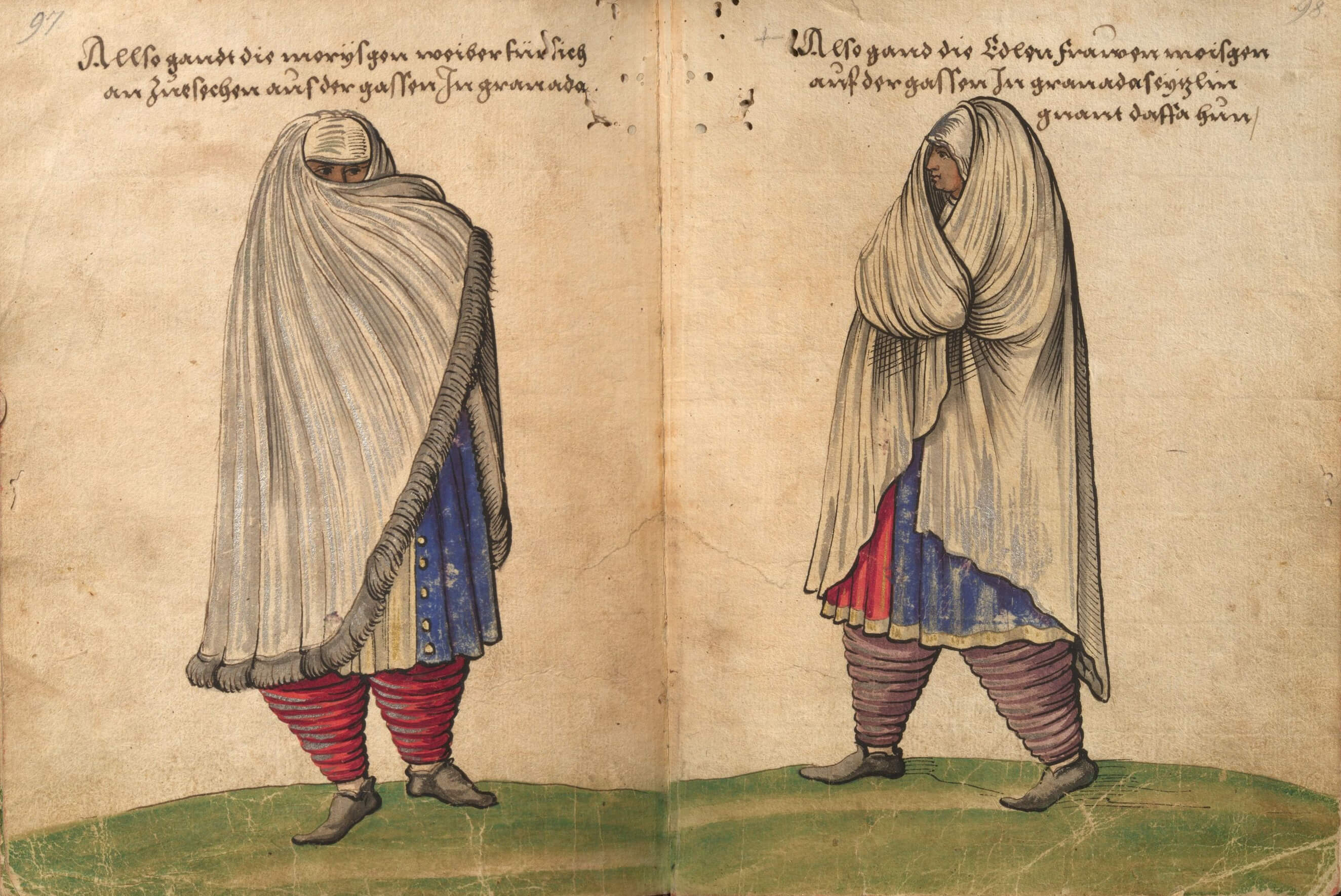 “This is how Moorish women walk through the streets of Granada”. Andalusia, Spain, 16th century. Trachtenbuch by Christoph Weiditz. Germanisches Nationalmuseum, Nürnberg.
The project draws primarily on judicial, ecclesiastical, and administrative sources, including inquisitorial records, court proceedings, secular and confessional literature, normative texts, and institutional and private correspondence, with a focus on the Iberian world and its imperial extensions from the sixteenth to the eighteenth centuries, and develops comparative case studies across different regions and urban contexts of the Hispanic Empire.
By bringing into dialogue legal norms and procedures, theological discourses, and practices documented in institutional and social sources, the project approaches privacy as a dynamic and negotiated process embedded in specific historical contexts. In doing so, SUBPRIVACY contributes to a relational understanding of privacy that foregrounds the interaction between law, conscience, and social belonging in shaping everyday experience in the early modern world.